

Short links that know what they are tracking
Every click on a Terminus short link or QR code is broken down by the fields on the record behind it. Business unit, region, funnel stage, whatever your model defines, alongside the usual geography and device.
Most shorteners stop at device and referrer
A shortener sees the click. It knows the country, the browser, and where the click came from. It does not know which business unit owns the campaign or which funnel stage it belongs to, because nothing ever told it.
Terminus, the marketing taxonomy governance platform builds the link from a governed record, so those fields are already attached before the first click arrives.
Your fields become dimensions
Every click carries a snapshot of the record's field values as they stood at click time. Group by business unit, region, or funnel stage the same way you group by country.
It is a snapshot, not a live join, so last March stays counted the way it was recorded.
Grouped by utm_source
- facebook42%
- google31%
- linkedin18%
- newsletter9%
Grouped by Business unit
- Enterprise38%
- Mid-market34%
- Self-serve21%
- Partner7%
The same clicks, grouped two ways. Business unit is a field on your governance model, not a UTM parameter. Illustrative figures.
Four ways to look at it
An overview across a taxonomy, a drill-in that stacks filters, a pivot cross-tab, and per-link stats. Overview and drill-in compare against the prior period. An overview URL reproduces the view for anyone who already has access to that taxonomy.
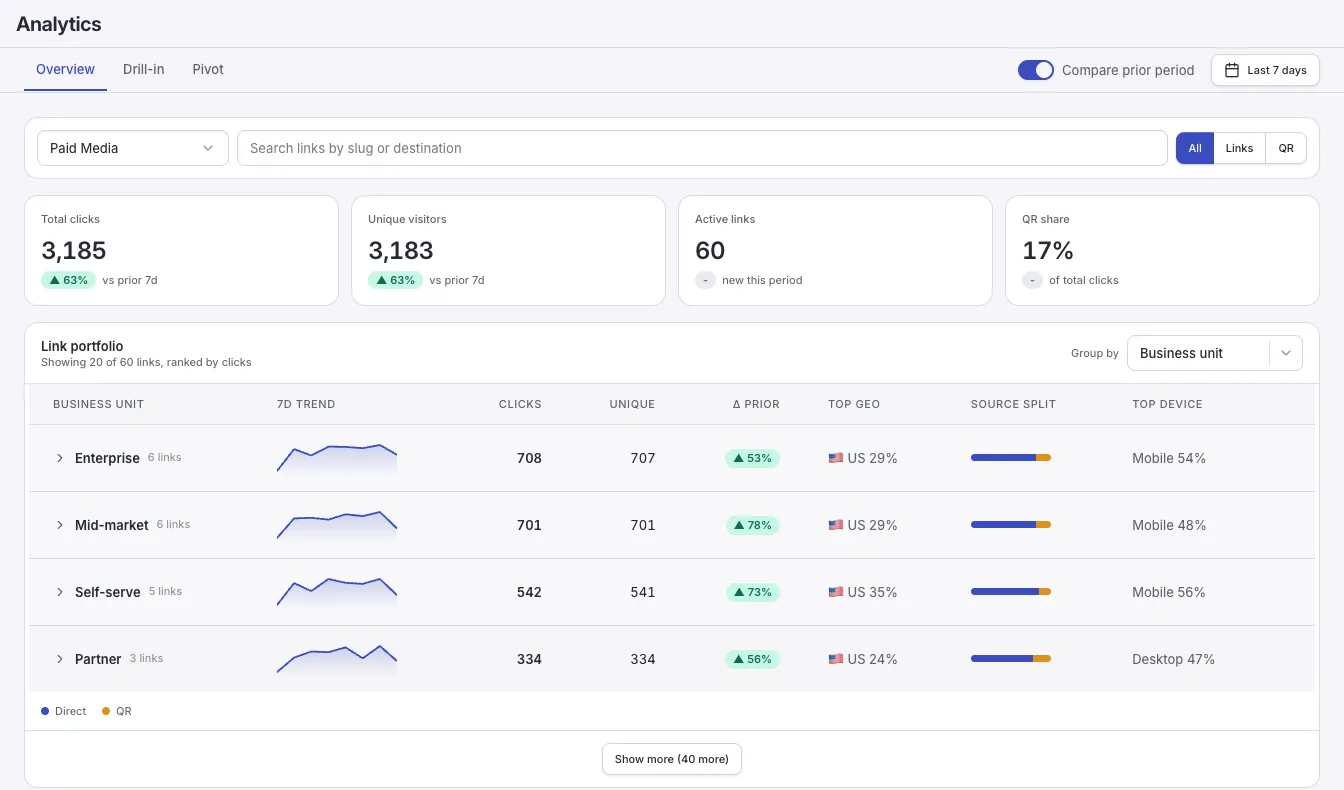
The Overview, grouped by Business unit. A field on the governance model, not a UTM parameter.
Filter by a field, not a parameter
Stack filters the way you would ask the question. Business unit is Enterprise, region is EMEA, and the whole view narrows to the five links that match.
Then break what is left down by any other field. Your own dimensions sit in the same list as country and device, because by the time the click arrives they are just columns.
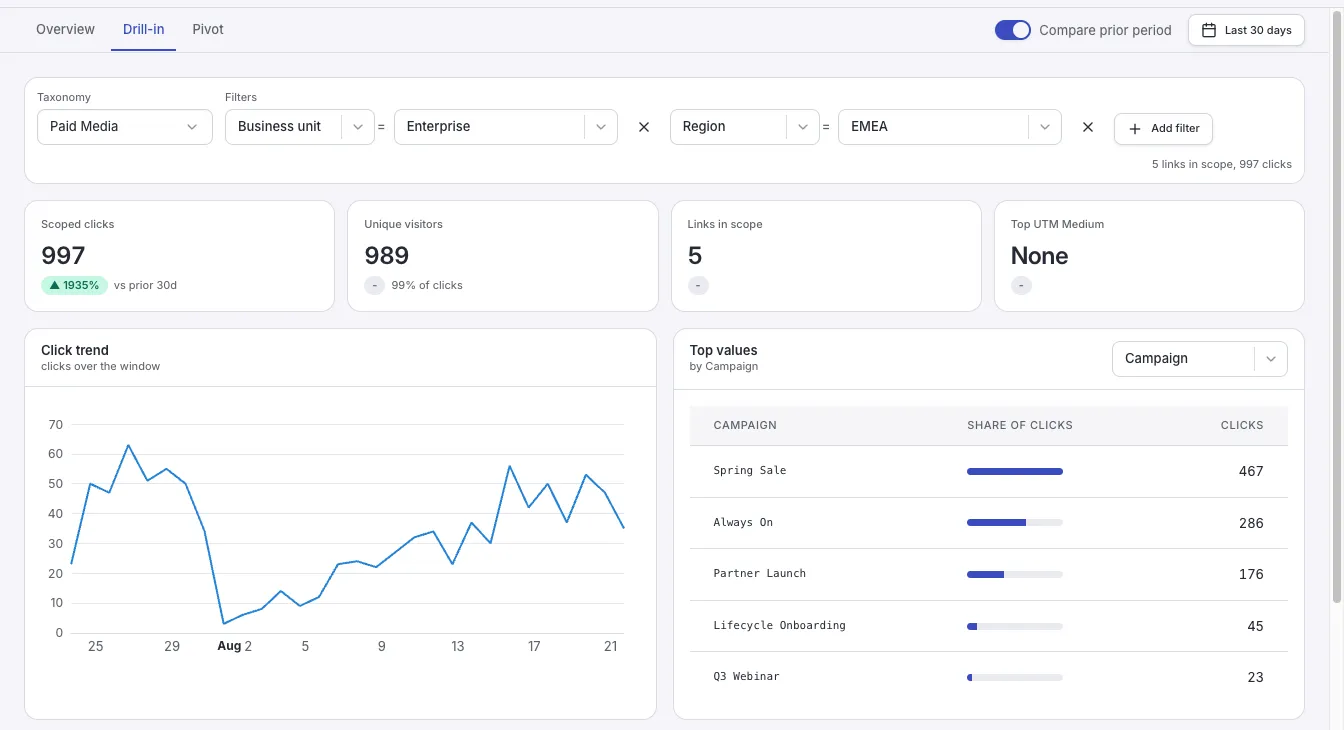
Two filters on governance fields, and the top values below them broken down by a third.
Where the numbers come from
The redirect resolves first and the click is queued behind it, so nobody waits on analytics to reach the page they asked for. Enrichment runs about half a minute later and derives geography from the IP address and device from the user agent.
That is also why the dashboard is near real time rather than instantaneous.
One link, on its own
Every short link has its own page: the trend over your chosen period, plus geography, device, browser, operating system, referrer, and the split between scans and clicks. It is the view for the question that starts with why is this one different.
What every click carries
Country, region, city, browser, operating system, device type, referring domain, the five UTM parameters, and the ad click identifiers. QR scans are counted separately from link clicks.
Unique visitors are a cookieless surrogate: a hash of IP and user agent. It is a coarse count, not an identity, and nothing follows anyone across devices.
This measures the link, not the session after it. What someone does once they land is what your web analytics is for, and the two answer different questions.
How long it is kept
One year of click history on Professional, two years on Business, and three on Enterprise. The capture itself is not plan-gated: what varies is how far back you can still look. See pricing.
See your clicks by your own dimensions
Build one governed link, click it, and watch it land in the dashboard under the fields you defined. 21 days, no credit card.